The Million Dollar Homepage, 21 years later
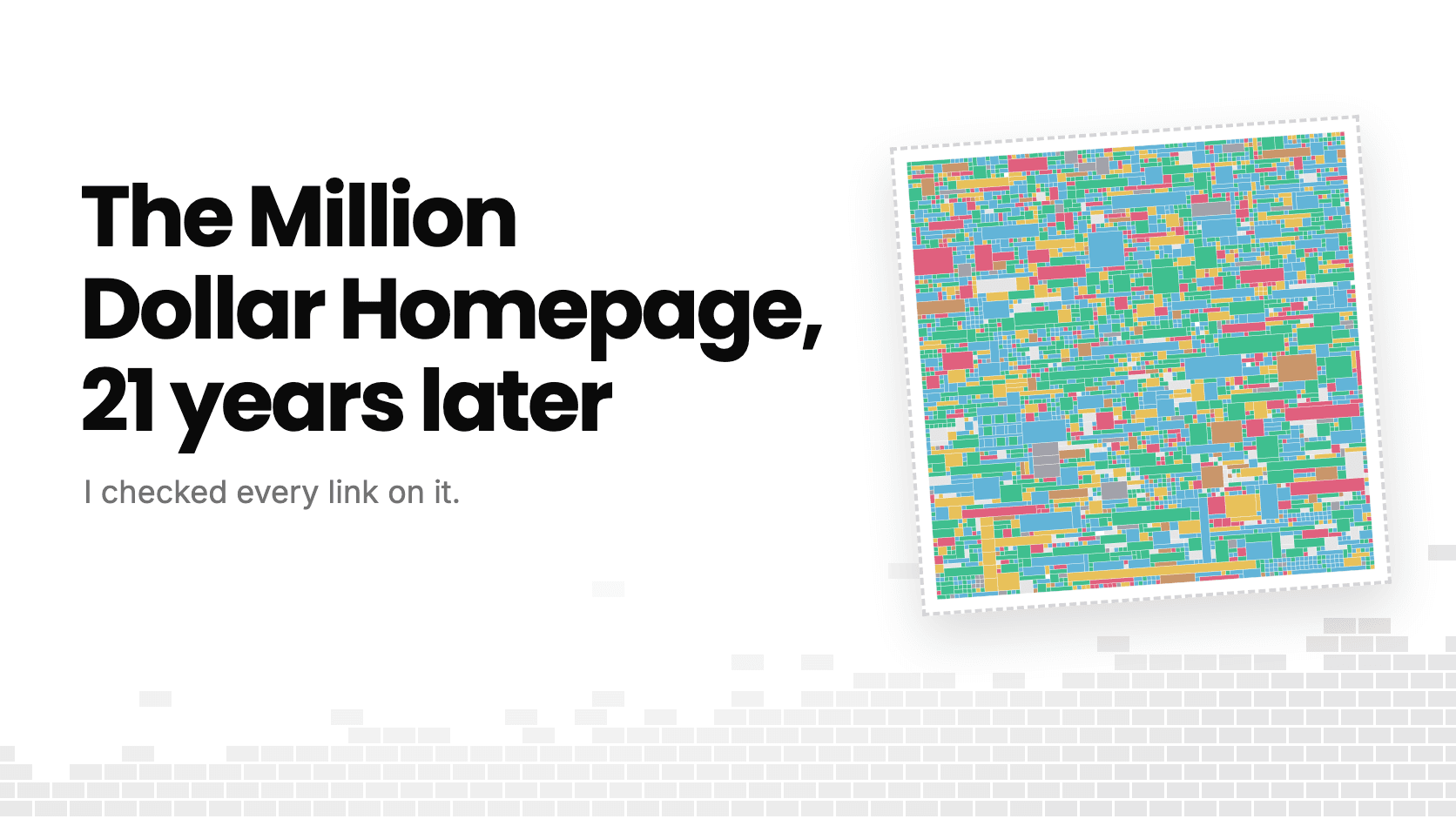
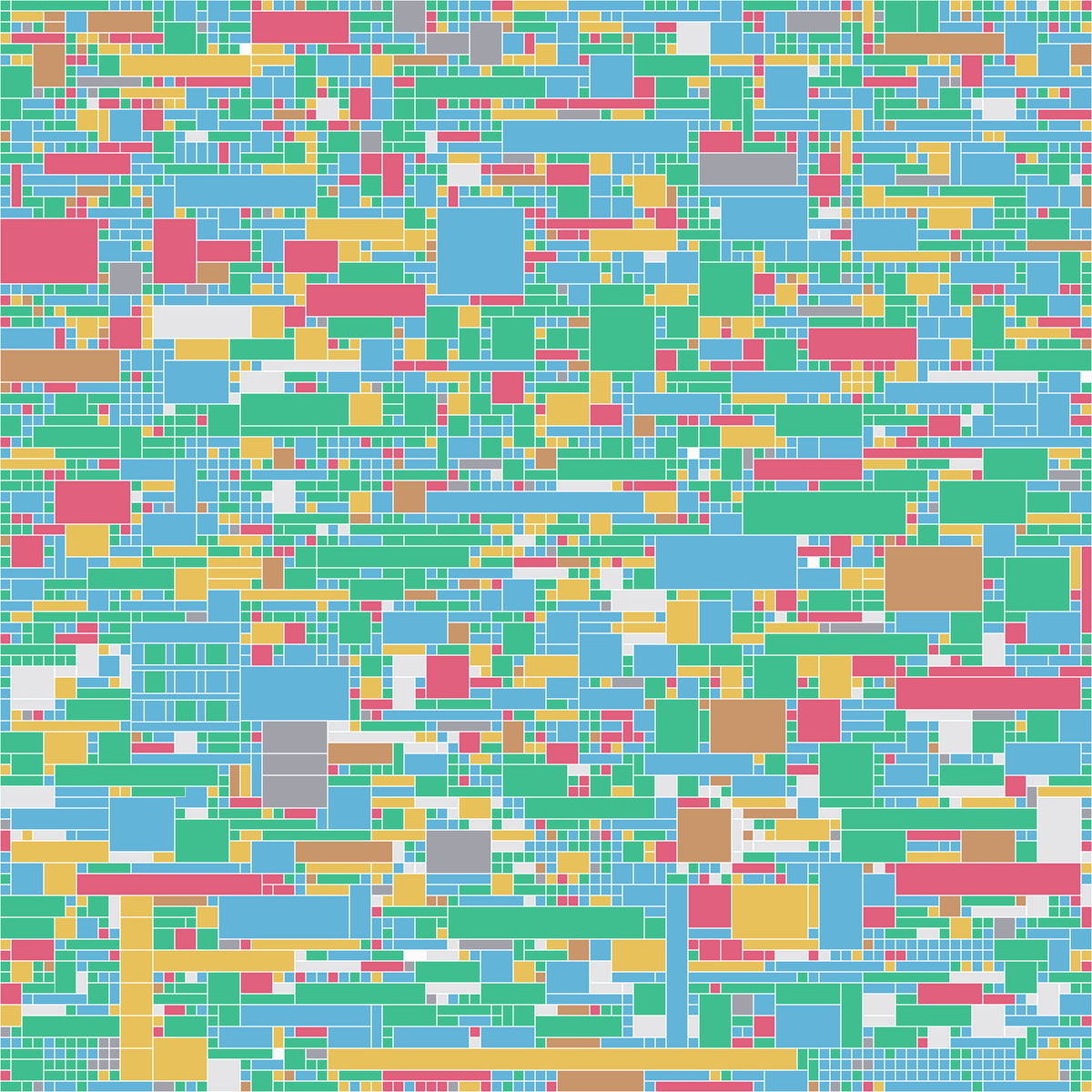
A student sold a million pixels for $1 each in 2005. I checked all 3,306 links: a third now lead to an archive, and about one pixel in seven still reaches its buyer.

November 3, 2026 · 7 min read
On 26 August 2005, a 21-year-old from Wiltshire called Alex Tew put a blank grid of a million pixels online and started selling it at $1 a pixel, to help pay for a business degree. Five months later it had brought in $1,037,100.
I run a wall of small rectangles that link out to people’s products, so I wanted to know how the original has held up. On 3 November 2026 I checked every link on it. A third of the page no longer links to its buyer at all: it now points at old copies in the Internet Archive. And only about one pixel in seven still reaches the business that paid for it.
| What a click does today | Links | Pixels | Share |
|---|---|---|---|
| Goes to an old copy in the Internet Archive | 1,164 | 332,380 | 33.3% |
| Loads a page | 1,039 | 305,820 | 30.6% |
| Domain for sale or parked | 403 | 128,100 | 12.8% |
| Error, or nothing there at all | 345 | 114,400 | 11.4% |
| Never had a real link | 143 | 45,800 | 4.6% |
| Empty page or spam | 121 | 44,000 | 4.4% |
| Refused my check | 91 | 28,800 | 2.9% |
A pixel cost $1, so the pixels column is also what those links were sold for.
How a student sold a million pixels
The pitch fit in one line: 1,000,000 pixels, $1 per pixel, own a piece of internet history. The smallest block was 10 by 10, so the cheapest ad cost $100. For that you got a tiny image, a link, and a promise that the page would stay up for at least five years.
The first sale came three days in, 400 pixels to a friend’s music site. Friends and family took 4,700 pixels in the first two weeks, and then the press found it. By late October more than 500,900 pixels had gone to 1,400 customers. Buyers included The Times, Yahoo!, Orange, Cheapflights, the band Tenacious D and a lot of online casinos.
By New Year’s Eve, 999,000 pixels were gone. Tew put the last 1,000 on eBay, where MillionDollarWeightLoss.com won them for $38,100. Then came the attack: someone calling themselves The Dark Group demanded $5,000, then $50,000, and hit the site with so much traffic that it was out for about a week. Tew’s answer to The Register: “I certainly don’t intend to pay them any money.”
He expected to keep $650,000 to $700,000 after costs and tax, and dropped out of Nottingham after one term. These figures come from Wikipedia’s account, which has the full timeline.
A third of the page now points at its own archive
The first surprise was at the very top of the page’s source code:
Million Dollar Homepage - Modified Version
Mode: broken_only
Only broken links have been replaced with Wayback Machine snapshots.
Links replaced: 1164
Generated: 2026-01-23 13:10:45
So in January 2026, a script swapped 1,164 links for copies in the Internet Archive’s Wayback Machine. The note doesn’t say who ran it, and I couldn’t find anyone writing about it. Those links cover 332,380 pixels, and 758 of the copies are from 2005. Click one of those blocks and you land on a website frozen in the year it bought its ad.
It’s a lovely fix, even if the archive is slow: half of a sample of 40 timed out when I tried them. It keeps the page working as a piece of history. It also means a third of the most famous ad space on the early web no longer advertises anything.
The original addresses are still in the page’s code, so I tested those too. 699 are dead, 110 are for sale or parked, and 216 load something. Undo the swap and 48% of the page would be dead, for sale or parked. People have been measuring this decline for years: Quartz found 22% of pixels dead in 2014, Harvard’s Library Innovation Lab counted 342,000 unreachable pixels in 2017, and the BBC reported about 40% of links dead in 2019. Everyone measured it differently, so it isn’t a clean trend, but it only goes one way.
Loading isn’t the same as surviving
Another third of the page still loads something, but that doesn’t mean the buyer is still there. When a domain lapses anyone can buy it, and the pixels go with it. So I read 220 random sites from this group by hand and compared each one with the text of its original ad. 107 were clearly the same business, 76 were something else, and I couldn’t tell with the other 37. That puts the share of the whole page still reaching its buyer at about 15%, or roughly one pixel in seven.
Some big names made it: Cheapflights, Chippendales, World Nomads and Schiffer Publishing are all still there. The Times still forwards to thetimes.com, Panda Software to Panda Security, and the University of Nottingham’s link to its Haydn Green Institute.
Others had stranger endings:
- tenaciousdfilm.com, the Tenacious D film site, now serves Chinese adult spam.
- fictionwise.com, once an ebook store, forwards to a Vietnamese football streaming site.
- toysdirecttoyourdoor.co.uk goes to someone’s TikTok account.
- pixellance.com, the biggest buyer on the page with 10,800 pixels, is for sale at HugeDomains.
- MillionDollarWeightLoss.com, which paid $38,100 for the final pixels, forwards to a generic weight loss tips site.
Then there are the 143 links that never went anywhere. Their address is just a note someone typed in, like “Pending Order” or “Reserved for Russian Fun Club”.
People are still buying in
This was my favourite find. A block on the page comes with whatever domain it points at, so people pick up the lapsed ones on purpose, just to own one. software-evaluation.co.uk is now a single page headed “million dollar graveyard”, whose owner writes: “When I found this opportunity to pick up a lapsed domain from the milliondollarhomepage I couldn’t resist it.” guzzleclub.com now calls itself “A pixel from the Million Dollar Homepage”. topspot-graphic.com is “un pixel rescatado”, a rescued pixel. And treeinaforest.com forwards to a GitHub tool for finding more of them.
Twenty-one years on, the tagline still works: own a piece of internet history. It just costs a domain registration now.
What I take from it
Selling once means nobody looks after it. Each block was paid for in 2005, and nothing on the page knows what’s behind it today. The Wayback swap came two decades in.
A link is only as strong as the domain behind it. When yours lapses, your ad belongs to whoever buys it next. That’s how a film promotion ends up as adult spam.
The idea worked once. It worked because it was new and the press loved it. About 9% of the page, 91,500 pixels, went to domains with “pixel” or “million” in the name, many of them people hoping to do the same thing. Tew tried again himself with Pixelotto and One Million People, and neither became the Million Dollar Homepage. His big one turned out to be something else entirely: the meditation app Calm.
Brick Launch is a cousin of this page: one wall, small rectangles, each one someone’s product. Each tool gets a page of its own rather than only a link, and its maker can edit it. But it isn’t immune. I ran a similar check on my own wall, which is two months old, and 245 of 256 links answered. A few of the other 11 just block automated checks, but some are already gone. Rot starts early.
If you’ve just built something, there’s a gap on the wall. It’s free with a badge, or $9 without. In 2005, $9 wouldn’t have bought you a thing: the smallest ad was $100.
Questions
Is the Million Dollar Homepage still online?
Yes, at milliondollarhomepage.com. Tew promised at least five years online, and it has now been 21. The grid of ads is still there, but a third of its links now go to archived copies.
Who created the Million Dollar Homepage?
Alex Tew, a 21-year-old from Cricklade in Wiltshire, England, who was about to start a business degree at the University of Nottingham.
How much money did it make?
$1,037,100 in five months, including $38,100 for the last 1,000 pixels. Tew expected to keep $650,000 to $700,000 after costs and tax.
What happened to Alex Tew?
He dropped out after one term, then built other projects including Pixelotto and PopJam. In 2012 he co-founded the meditation app Calm with Michael Acton Smith.
How many of its links still work?
Of 3,306 links, 1,039 load a page and 1,164 go to an archived copy. The rest are for sale, parked, empty, dead or never had a real address. Of the links that load a page, just under half still lead to the original business.
How I checked
I took the page’s source on 3 November 2026, which has 3,306 links covering 999,300 pixels, and requested each address, retrying failures a minute later. I opened 412 unclear ones in a real browser, because some sites only reveal themselves once their scripts run. Pattern rules sorted the rest, and I spot-checked those by hand.
It’s one day from one machine, so a site that happened to be down counts as dead, and 91 links refused automated checks altogether. “Same business” is my own judgement, from comparing each ad with the page it leads to today.